
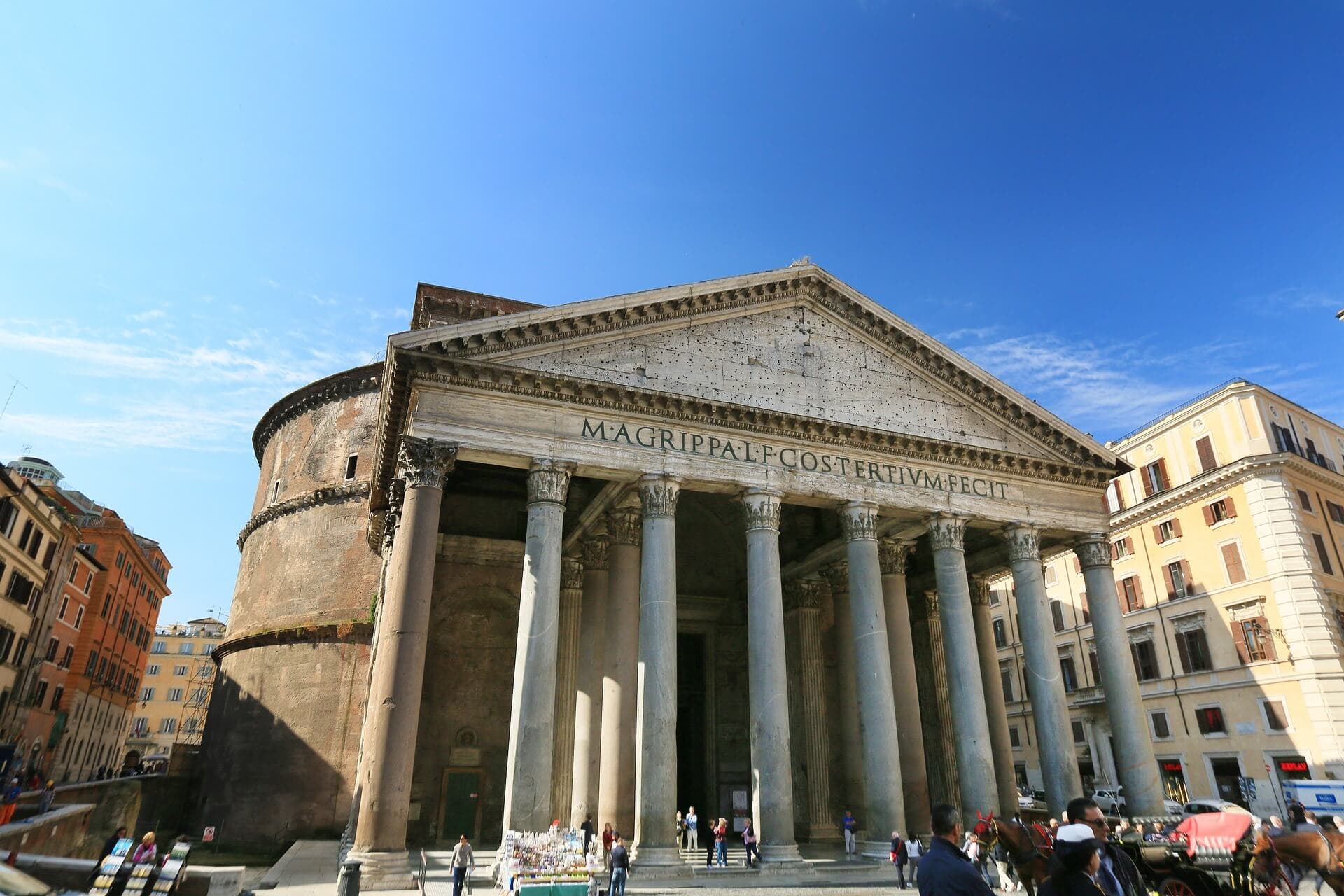
The Pantheon in Rome is, without a doubt, one of the most famous monuments in the world. A quick glance at the building is all it takes to realize that this building perfectly encompasses the city's evolution over thousands of years. Telling its history is basically the same as recounting the history of Rome itself.
But what is the Pantheon?
The answer to this question can be found in its very name. "Pantheon" comes from the ancient Greek Πάνθεων [ἱερόν], which means "[temple] of all the gods". The Pantheon was Rome's temple par excellence, a place of worship dedicated to all the deities that were most important to the Romans.
It was commissioned in 27 BC by Marcus Vipsanius Agrippa, a Roman consul, and son-in-law to the emperor Augustus. The construction was overseen by architect Lucius Cocceius Auctus, who had already completed numerous projects on behalf of the imperial family.
Of course, they couldn't use just any piece of land in Rome to build the temple. The Pantheon rises up from the ancient Palus Caprae, a marshy area in the center of Campo Marzio, a district of the city named after the god Mars. Legend has it that Romulus, the first King of Rome and son of Mars himself, ascended into heaven from that very spot. There couldn't be a more perfect place for a temple.
However, the building we see now isn't the one requested by Agrippa. Sources say that the original temple had a rectangular shape with the entrance facing south. This was the direction in which the Etruscans, the civilization that gave us some of the first kings of Rome, traditionally laid their dead.
To affirm his dynastic ties, Agrippa had a statue of himself and one of Augustus built on either side of the large bronze doors. Inside, he also had a statue of Julius Caesar added to the Olympus of venerated deities. Unfortunately, these original decorations have not survived, due to a great fire that destroyed Agrippa's masterpiece around 110 AD. The Pantheon first built by Agrippa went on to be damaged and restored several times over the centuries. In fact, both the emperors Domitian and Trajan attempted to rebuild it, but without success. It wasn't until the arrival of emperor Hadrian that the structure was definitively rebuilt between 118 and 125 AD, resulting in the Pantheon that we still admire today.
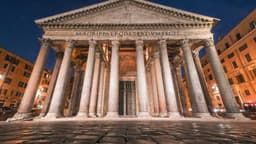
Driven by a great love of history and respect for his predecessors, Hadrian insisted on leaving Agrippa's name on the architrave of the new Pantheon with an inscription that is still clearly visible today: M. AGRIPPA L.F. COS. TERTIUM. FECIT. Meaning: Marcus Agrippa, son of Lucius, consul three times, made this.

Despite this tribute, the emperor radically changed the architectural features of the temple. The project was probably entrusted to the architect Apollodorus of Damascus, who designed the building that we see now: a circular shape oriented towards the north.
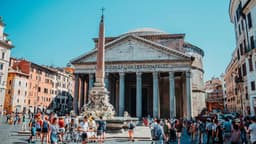
Hadrian's Pantheon has two main parts: the portico, also known as the pronaos, consisting of 16 columns; and the large central hall, also called the Rotonda due to its shape, surrounded by walls that are 6 meters thick.
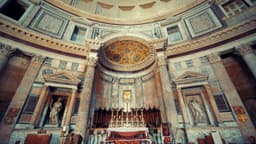
Though not immediately clear when viewed from the outside, once visitors enter the building it becomes obvious that the space forms a sphere. Hadrian's vision required a perfect geometric shape, and the diameter of 43.44 meters does indeed correspond to its height.
The creation of such a large internal space was also due to another requirement. Ever since its first construction in Agrippa's time, the Pantheon in Rome stood out among the other pagan temples because it could accommodate the worshippers within its walls, whereas other structures usually required religious rites to be attended outside. Indeed, according to pagan tradition, only priests could cross the sacred threshold.
Up to this point, the history of the Pantheon is already enough to define it as a symbol that embodies the Roman imperial period and the customs of its people. However, there is one more architectural element in particular that has truly made the Pantheon one of the most admired and unique buildings in the world: the dome.
Due to its proportions, it is difficult to appreciate the dome in its entirety when facing the building. To truly admire it from the outside, you need to be much farther away and higher up. From some of Rome's panoramic terraces, the dome becomes unmistakable: it seems to grow not in height, but in width, expanding its diameter across the entire perimeter of the building.
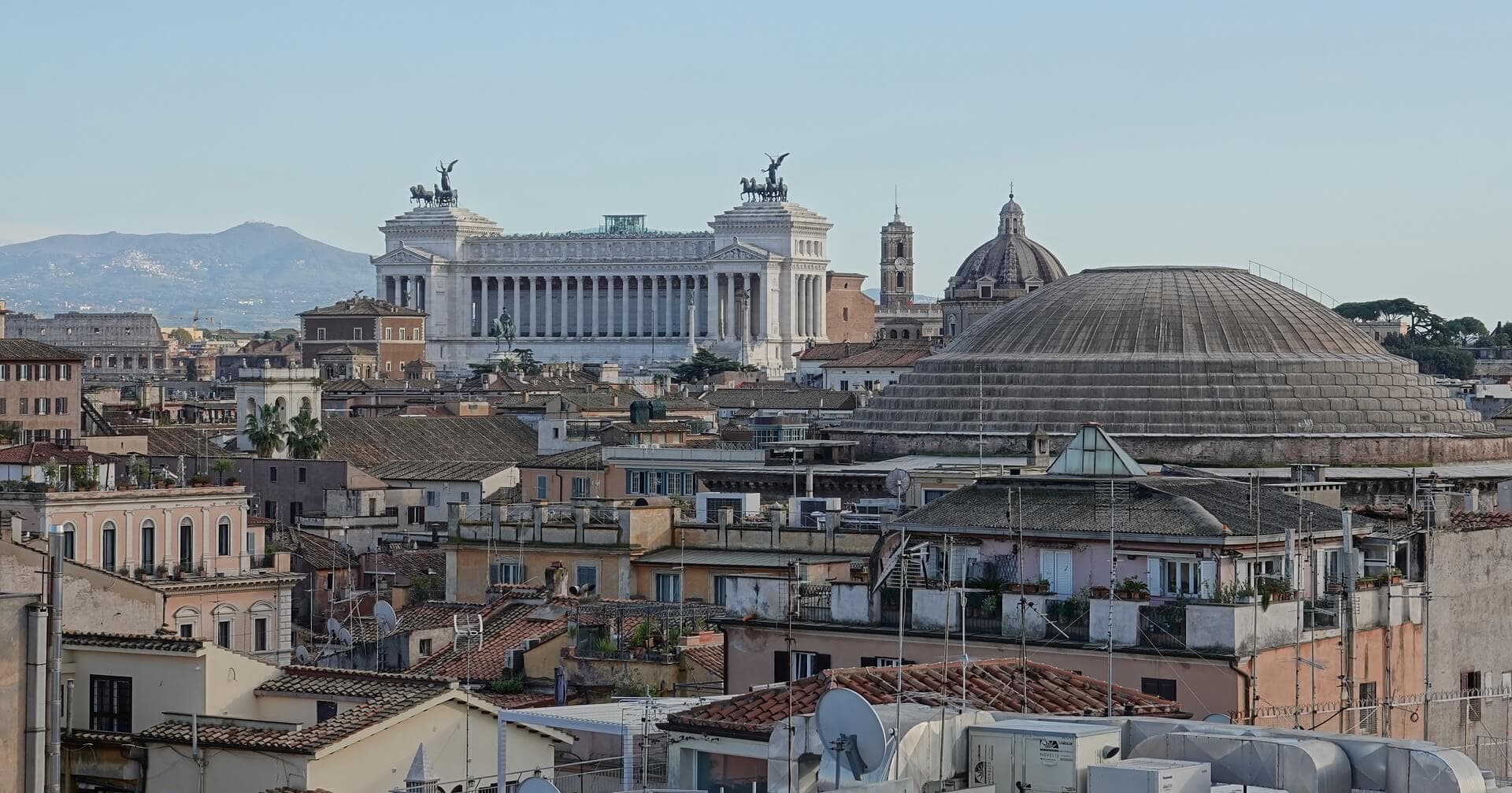
The structure of the monument itself is simply a base for its dome.
The size alone is astonishing, as is the gigantic coffered roof, but what makes this dome even more incredible is the opening at the very top.
Here you will find the oculus, an opening with a diameter of nine meters that interrupts the arch of the dome, giving the impression that it has been suspended in midair. A construction technique that impressed the great Michelangelo so much that he confessed that the dome of the Pantheon appeared to be the work of angels, not men.
But why was it left open? Read more about it on our page dedicated to the Oculus and the Dome. Its architecture has not changed over time, and the simple fact that we can still admire the same structure and visual phenomena as people have for thousands of years forces us to reflect on the genius of the Roman people.
It is no surprise that the great French writer Stendhal described the building as "the most beautiful remnant of Roman antiquity [...] it appears as the Romans must have seen it in their times".
But has the Pantheon really remained unchanged since Ancient Rome?
While Stendhal's statement is certainly true in many respects, it should be noted that the Pantheon we admire today is actually quite different from the original building in several ways, both in decoration and function.
The pagan temple envisioned by Agrippa and rebuilt by Hadrian has actually transformed into a Christian church over the centuries. Just as the Pantheon perfectly embodied the soul of imperial Rome, it continued to reflect the transformation of the Roman people when Christianity took root during the 4th century.
This religion radically changed Rome's traditions and way of thinking. The Olympus of pagan divinities was gradually replaced with the new word of God, and the Pantheon fell into a period of abandonment before transforming into a Christian church.
With the fall of the Western Roman Empire in the 5th century, the building became neglected and its monumental appearance succumbed to irreversible architectural and artistic decay.
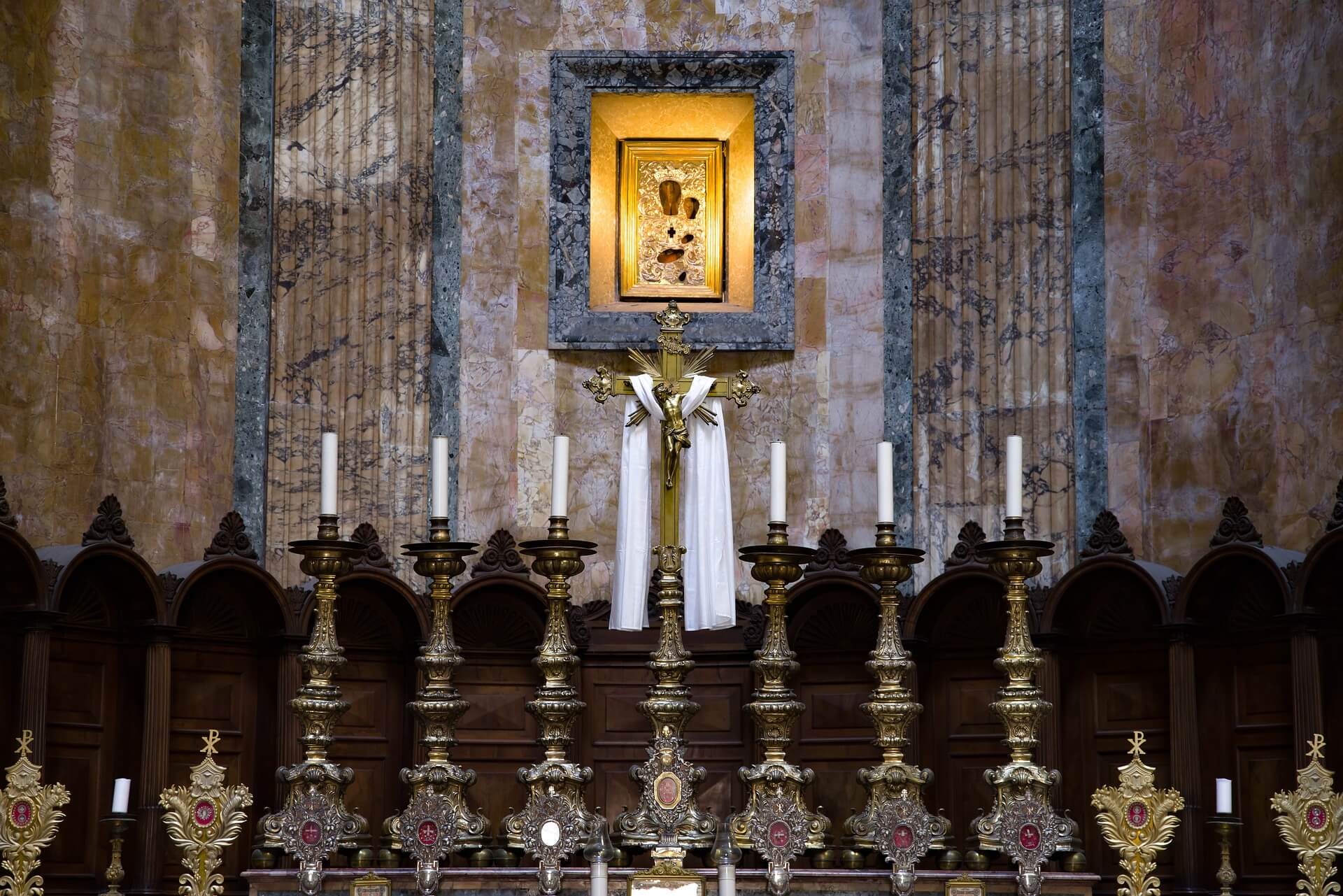
Eventually, in 609 AD, the Byzantine emperor Phocas gave the Pantheon to Pope Boniface IV. This was a demonstration of loyalty and respect towards the ancient capital of the former Empire and the Pope decided to emphasize the new Christian course of the city by transforming it into a church dedicated to St. Mary and the Martyrs. This temple to planetary deities and emperors thus became a Christian cradle dedicated to those who died at the hands of vicious pagan persecution. Documents tell us of the purification process, some even claiming that Pope Boniface IV buried twenty carts of martyrs' bones in the basement of the building.
The transformation into a Christian church gave the structure some protection throughout the looting and conflict that plagued Rome during the medieval period. However, it still became a popular site for builders to harvest precious materials, useful in the modernization of the papal city.
This plundering over the centuries has left us with a structure that is almost completely devoid of its original marble and bronze. Fortunately, "the sacking" of the Pantheon did not affect its structural integrity.
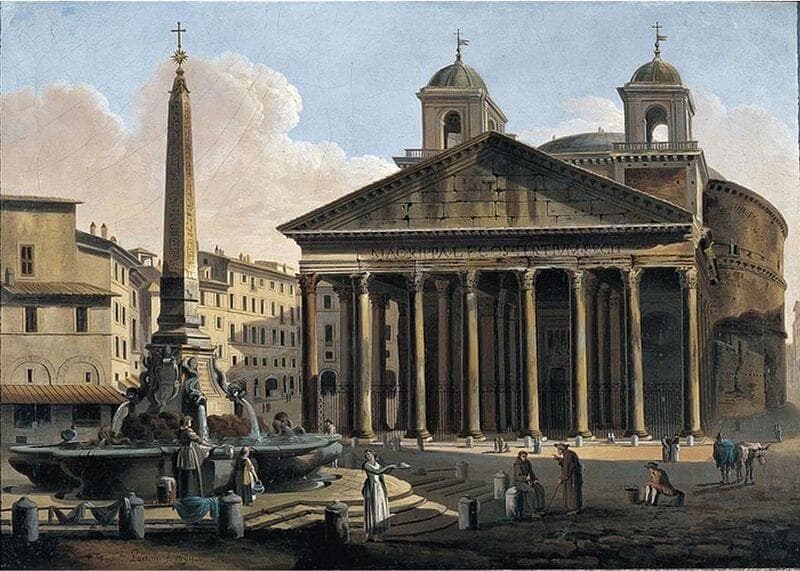
Two significant requisitions dramatically changed the Pantheon's appearance. In 735 Pope Gregory III removed the dome's bronze cover and replaced it with lead sheeting, greatly damaging the appearance of the dome itself. Then, in 1632, Pope Urban VIII removed the bronze that covered the beams of the portico entrance and repurposed it for the artillery of Castel Sant'Angelo.
It is said that Pope Urban VIII used the bronze not only for the fortress cannons but also to create the monumental canopy in St. Peter's. However, recent studies lead scholars to believe that this was just a "holy" justification used by the pontiff to appease the angry Romans when he began dismantling the Pantheon.
Urban VIII also had two bell towers built on either side of the Pantheon, and though they were created by the genius Gian Lorenzo Bernini, the Romans hated them so much that they referred to them as "the donkey ears". The growing resentment towards Urban VIII and his actions made him and his family (the Barberini) a target of great derision, resulting in the popular saying that "what the barbarians did not do, the Barberini did".
Inside the Pantheon, only two decorative elements have reached the modern age intact: the huge bronze door, more than seven meters high, and the floor made of precious marble, including granite, white Pavonazzo marble, and yellow marble. Some sections of the floor also include red porphyry from the only existing quarry in Egypt, now depleted.
While centuries of plundering left only the skeleton of the Pantheon, the city around the building continued to change as well. The ancient staircase that once rose up towards the entrance gradually sank below the modern street level. In fact, the original level of the entire ancient city is now six to twelve meters below ground.
The interior of the Pantheon also experienced dramatic transformations. The niches that once housed the statues of pagan deities, so dear to the Romans for centuries, now held the statues of Christian saints. During the 16th and 17th centuries, every part of the circular hall was enriched with altars and modern furnishings.
The interior of the Pantheon never received an organized and comprehensive redecoration but was rather the result of numerous artists attempting to leave their mark within the ancient Roman temple, evidence that the building never lost its charm over the centuries.
Thanks to the unique architecture that brought it such international fame, the Pantheon has been, and continues to be, one of the most imitated monuments of the modern and contemporary era. Architects and artists have long competed with each other in their attempts to create buildings and monuments inspired by the Roman masterpiece.
A prime example of this is Villa la Rotonda in Vicenza, built by Andrea Palladio for the priest Paolo Almerico. The architect immediately declared his source of inspiration, considering the Pantheon an absolute masterpiece of ancient Rome. Similarly, the Basilica San Francesco di Paola, built by Pietro Bianchi in Naples, clearly pays homage to Hadrian's ancient temple.
However, this fascination with the Pantheon did not stop at the Italian border. It went on to influence generations of scholars and artists overseas as well. Such as Thomas Jefferson, third President of the United States of America, who carefully followed the architectural projects of Rome and replicated the Pantheon for the University of Virginia as well as for his villa in Monticello near Charlottesville.
The Pantheon even became a burial place for many famous artists and public figures including Raffaello Sanzio (more commonly known as Raphael) and the Italian royal family. The presence of royalty is also why you will find an Honor Guard inside the building.
The interior hasn't undergone any further transformations since the mid-twentieth century, limiting all projects to conservation and restoration efforts. Today the monument is protected under the Superintendence of Rome and is considered the property of the Italian state.
When discussing the Pantheon we must always consider the fragile balance of its very existence. Even though it was built almost two thousand years ago, its perfectly preserved structure continues to accommodate thousands of people every day.
Each page in the Pantheon's history is therefore also a record of Rome's own transformation as a city.
From the capital of the Roman Empire, to the cradle of Christianity, and finally up to the modern day: the capital of Italy and a treasure trove of priceless artistic treasures. In the words of the famous German writer Goethe, The Pantheon makes it clear that: “only in Rome is it possible to understand Rome”.


Vox City, The Vox Group's Dedicated Business-To-Consumer Arm For The Past Five Years, Is Staffed By Veteran Travel Industry Experts With A Combined 21 Years Of Expertise In The Tourism Industry. Let's Explore The Beauty Of Travel In Your Own Way At Your Own Pace.


Vox City International 63 Holly Walk | CV32 4JG Leamington Spa
2026 Vox City, All rights reserved.